Forgotten America: How the Electoral College Turns 40 States Into Political Afterthoughts
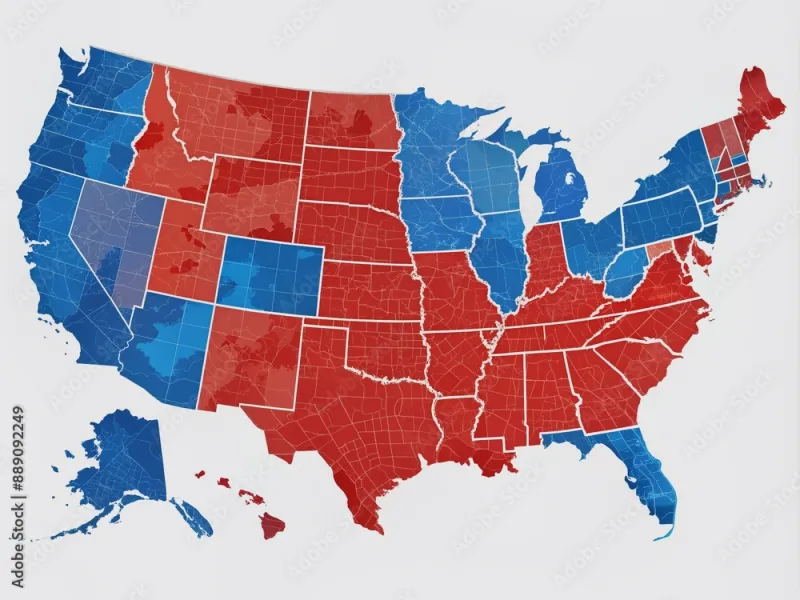
Photo: United States electoral map with highlighted swing states political campaign, via as1.ftcdn.net
In the final weeks of the 2024 presidential campaign, both major-party candidates made dozens of campaign stops. Nearly all of them took place in fewer than eight states. Pennsylvanians, Arizonans, and Georgians were courted relentlessly. Meanwhile, voters in Oklahoma, Massachusetts, Wyoming, and California were left to watch from the sidelines—their electoral votes already accounted for before a single ballot was cast.
This is not a bug in the American presidential election system. For many political strategists, it is a feature. But for the tens of millions of Americans who live outside the narrow band of competitive states, it increasingly feels like disenfranchisement by design.
The Geography of Political Relevance
The United States has 50 states, yet in any given presidential election cycle, roughly 40 of them are considered non-competitive. Political scientists and campaign operatives refer to these as "safe" states—reliably red or reliably blue—and their residents are, in the cold arithmetic of modern campaigning, largely irrelevant to the outcome.
According to data compiled from Federal Election Commission filings, the 2020 presidential election saw roughly 96 percent of all campaign events held in just 12 states. Six states—Pennsylvania, Michigan, Wisconsin, Florida, Arizona, and North Carolina—accounted for the lion's share of candidate appearances, advertising spending, and ground-game investment.
The implications extend well beyond where candidates choose to hold rallies. Research from scholars at the University of Wisconsin and Fairleigh Dickinson University has consistently demonstrated that swing states receive disproportionate federal attention in the form of disaster relief, infrastructure grants, and executive policy announcements—particularly in the years immediately preceding an election. The presidency, in this sense, does not merely campaign in swing states. It governs through them.
A System Built for a Different Era
The Electoral College was designed by the Framers as a compromise between direct popular election and selection by Congress. In the late eighteenth century, with no national communication infrastructure and limited means of assessing public opinion across a vast and fragmented republic, the system made a certain structural sense. Electors from each state would exercise informed judgment, aggregating regional preferences into a national outcome.
That rationale has long since evaporated. In its place, the winner-take-all allocation of electoral votes—adopted by 48 states and the District of Columbia—has created a powerful incentive for campaigns to concentrate resources wherever marginal votes carry the greatest electoral return. A Democrat who wins California by 3 million votes receives the same 54 electoral votes as one who wins it by 30,000. The surplus is worthless. The math rewards efficiency, not breadth.
"The current system doesn't ask candidates to build a national coalition," said one veteran Democratic strategist who has worked on three presidential campaigns. "It asks them to win a very specific map. Those are fundamentally different challenges."
The Policy Consequences of Geographic Neglect
The distortions produced by this system are not merely symbolic. Policy priorities tend to reflect the concerns of voters who are actually being competed for. Agricultural subsidies that disproportionately benefit Midwestern swing states, energy policy shaped around the specific economies of Pennsylvania and Michigan, trade negotiations calibrated to the manufacturing concerns of Wisconsin—these are not coincidences. They are the downstream consequences of a campaign infrastructure that treats competitive-state voters as the only constituents who truly matter in a presidential race.
Conversely, states that are written off early—whether solidly Republican like Kansas and Tennessee or solidly Democratic like Maryland and Hawaii—find their particular economic and social concerns subordinated to the preferences of voters elsewhere. A rancher in Montana and a tech worker in California may both feel, with some justification, that the presidency is not campaigning for them.
This dynamic also shapes the national political conversation in subtler ways. Media coverage tends to follow campaign activity. Issues that resonate in swing states receive sustained national attention; those that are salient primarily in non-competitive states are often relegated to regional coverage at best.
Reform Proposals: From Incremental to Radical
The debate over Electoral College reform is not new, but it has gained renewed urgency in the wake of elections in which the popular vote winner lost the presidency. Several distinct reform models have emerged from academic and policy circles.
The National Popular Vote Interstate Compact (NPVIC) represents the most politically advanced reform effort currently underway. Under this arrangement, participating states agree to award all of their electoral votes to whichever candidate wins the national popular vote—but only once states controlling at least 270 electoral votes have signed on. As of early 2025, states representing 209 electoral votes have enacted the compact. Proponents argue it would effectively nationalize presidential campaigns without requiring a constitutional amendment. Critics contend it creates its own set of legal and structural complications.
Proportional allocation of electoral votes is another model, in which states distribute their electors in proportion to each candidate's share of the popular vote within the state. Maine and Nebraska already use a variant of this approach, allocating two electors to the statewide winner and one elector per congressional district. Broader adoption would, in theory, make more states marginally competitive at the electoral vote level.
Direct popular election remains the most straightforward solution and the most constitutionally demanding. Abolishing the Electoral College entirely would require a constitutional amendment—a process requiring two-thirds approval in both chambers of Congress and ratification by three-quarters of states. Given that smaller, predominantly Republican states benefit from the current system's allocation formula, the political feasibility of this path is extremely limited in the near term.
The Partisan Calculus
Any serious discussion of Electoral College reform must reckon with the partisan interests at stake. Republicans have won the presidency twice in the last quarter-century while losing the popular vote—in 2000 and 2016—creating a structural incentive for the party to resist reforms that would shift the presidential calculus toward raw national vote totals. Democrats, having benefited from the college in other cycles, are not uniformly in favor of abolition either.
The honest assessment is that electoral reform of this magnitude requires either a significant shift in partisan self-interest calculations or a crisis of democratic legitimacy severe enough to generate bipartisan consensus. Neither condition currently exists.
What Remains at Stake
The swing-state paradox is, at its core, a question about the nature of democratic representation. A system that structurally concentrates presidential attention on a small subset of the electorate produces a presidency that is, in important ways, accountable to a fraction of the nation it governs.
For the roughly 230 million Americans who live in non-competitive states, this is not an abstract concern. It shapes which infrastructure projects get federal attention, which industries receive executive support, and which communities find their concerns reflected in national policy debates.
The Framers designed the Electoral College to produce a president who could claim legitimate authority across a diverse and divided republic. Whether the current system still serves that purpose—or whether it has become an instrument of geographic exclusion—is a question that American democracy has yet to fully answer.