Subpoena Today, Retainer Tomorrow: The Hidden Career Logic Behind Congressional Investigations
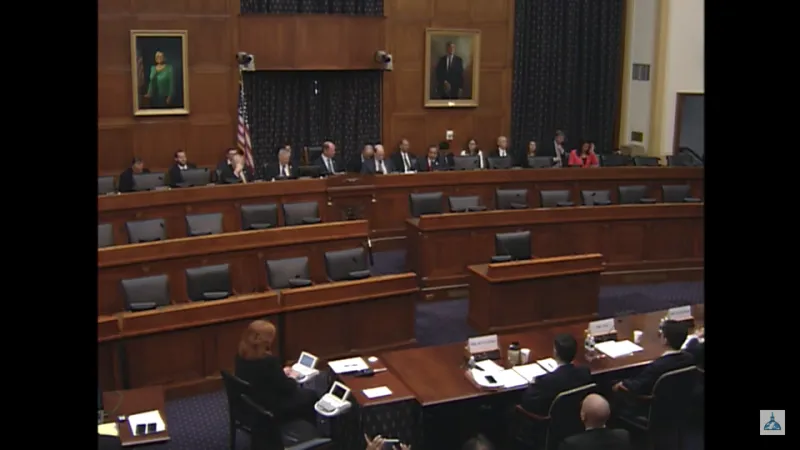
Photo: US Congress - House Foreign Affairs Committee, Public domain, via Wikimedia Commons
When a congressional committee chair trains the full weight of investigative authority on a powerful industry, it rarely signals the beginning of a sustained accountability campaign. More often, it marks the opening bid in an unspoken negotiation—one whose final terms are settled years later, far from Capitol Hill, in the corner offices of K Street advisory firms.
This is not a story about corruption in its most cartoonish form. No envelopes change hands in parking garages. No explicit promises are made across hearing room tables. What exists instead is something more structurally durable: an incentive architecture that transforms the tools of democratic oversight into instruments of personal career advancement—and in doing so, quietly hollows out the very accountability mechanisms the public depends upon.
The Anatomy of a Performative Inquiry
Congressional investigations carry enormous symbolic weight. A subpoena issued by a standing committee commands attention from boardrooms, newsrooms, and financial markets alike. Executives are summoned. Documents are demanded. Witnesses sweat under the glare of C-SPAN cameras while lawmakers deliver pointed soliloquies that double as campaign-trail highlights.
Yet the resolution of these inquiries frequently fails to match their theatrical intensity. Reports are released with muted fanfare. Referrals to the Justice Department gather dust. Recommended legislative remedies never advance through the legislative calendar. The industry in question absorbs the temporary reputational bruise, adjusts its communications strategy, and moves on.
What changes, however, is the relationship between the lawmakers who conducted the inquiry and the sector they appeared to scrutinize. Former committee members and senior staff emerge from these episodes with something invaluable to prospective employers: intimate knowledge of where the regulatory bodies are soft, which investigative pressure points produce the most political heat, and—crucially—how to defuse them.
The Expertise Premium
Washington's influence industry has always placed a premium on insider knowledge, but the specific expertise generated through adversarial oversight commands a particularly high market rate. A former senator who once subpoenaed pharmaceutical pricing records does not merely understand the industry from a policy perspective. He understands precisely how a congressional investigation is assembled, which documents regulators find most damaging, and how to counsel a company through the experience of being on the receiving end of the same process he once directed.
This creates what analysts sometimes call the "expertise premium" in post-congressional employment—a measurable salary differential between former members who sat on powerful investigative committees and those who did not. The more aggressive the oversight record, the more comprehensive the knowledge base. And the more comprehensive the knowledge base, the more attractive the eventual advisory contract.
The incentive this generates is deeply perverse. A lawmaker who conducts genuinely rigorous oversight—one that results in enforceable penalties, meaningful legislative reform, and lasting behavioral change within a regulated industry—has effectively burned the bridges that would otherwise lead to a lucrative second career. The industry has no use for someone who actually damaged it. But a lawmaker who stages a credible performance of accountability while stopping well short of genuine consequence has demonstrated both competence and restraint: exactly the combination K Street values most.
The Revolving Door's Quieter Mechanism
Much of the public discourse around Washington's revolving door focuses on the movement of regulators into the industries they once policed—a dynamic this publication has examined in prior analysis. Less attention has been paid to the parallel phenomenon playing out within Congress itself, where the investigative function of the legislative branch has become entangled with the post-service employment ambitions of its members.
The legal framework governing this transition is, by any rigorous standard, inadequate. Former senators are barred from directly lobbying their former colleagues for two years after leaving office; former House members face a one-year cooling-off period. But neither restriction prevents a former lawmaker from serving as a strategic consultant, advising clients on how to navigate the very oversight processes they once administered. The distinction between "lobbying" and "consulting" has grown so porous as to be functionally meaningless in many cases, yet it remains the primary regulatory boundary separating permissible conduct from prohibited influence-peddling.
Senior committee staff face even lighter restrictions despite often possessing more granular operational knowledge than the elected officials they serve. A veteran counsel to the Senate Judiciary Committee who helped construct a multi-year antitrust investigation can exit federal service and begin advising technology companies on antitrust exposure the following week, provided the technical requirements of existing ethics rules are satisfied.
When Oversight Becomes a Calling Card
Perhaps the most telling indicator of how thoroughly this dynamic has been internalized is the way some former lawmakers market themselves in the private sector. Advisory firm profiles and speaker bureau listings routinely highlight a former member's record of "aggressive oversight" or their tenure chairing committees with broad investigative jurisdiction—not as evidence of public service, but as a credential demonstrating their value to paying clients.
The implicit message is unambiguous: this person knows how the machinery works because they once operated it. They know what a subpoena looks like from the inside, how committee staff build evidentiary records, and at what point an investigation typically loses political momentum. That knowledge, packaged as strategic counsel, commands annual retainers that dwarf a congressional salary many times over.
For industries facing potential regulatory scrutiny—financial services, pharmaceuticals, technology, energy—retaining former oversight architects is not simply about lobbying in the conventional sense. It is about threat intelligence: understanding when a congressional investigation represents a genuine institutional commitment to accountability versus a temporary political performance that will fade after the election cycle turns.
The Structural Reform Gap
Addressing this problem requires confronting an uncomfortable reality: the reforms most likely to disrupt the subpoena-to-retainer pipeline are also the reforms that sitting lawmakers would be required to enact against their own future career interests. Extending post-service lobbying and consulting restrictions to five or seven years, closing the distinction between direct lobbying and strategic advisory work, and creating meaningful disclosure requirements for former members who advise industries they previously investigated would all represent substantive improvements to the existing framework.
Some good-government organizations have proposed the creation of an independent congressional ethics enforcement body with genuine investigative authority—an institution capable of examining whether the pattern of oversight activity and subsequent employment reflects a conflict of interest that existing rules fail to capture. These proposals have found little traction among the members who would need to vote them into existence.
Until the structural incentives change, the pattern will persist. Congressional investigations will continue to serve dual purposes: as instruments of democratic accountability in their public presentation, and as career-building exercises in their private logic. The industries being investigated will continue to understand this distinction, budgeting accordingly for the advisory fees that follow. And the public will continue to watch televised hearings with the nagging sense that something important is being left unresolved—without quite being able to name what it is.
The answer, in most cases, is that the resolution is simply being deferred. The terms are being negotiated in a different room, on a different timeline, at a rate that will never appear in any committee report.