Wink and Nod: How Outside Groups and Campaigns Coordinate Without Ever Technically Talking
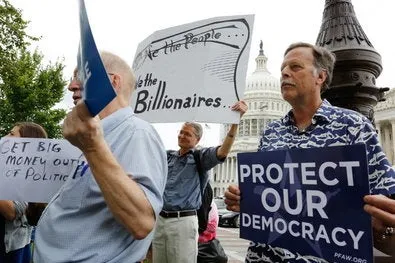
Photo: dark money political campaign finance outside groups Washington DC, via static01.nyt.com
The legal prohibition on coordination between political campaigns and outside spending groups sits at the very foundation of post-Citizens United campaign finance law. The theory is straightforward: if a super PAC or dark money nonprofit cannot consult with the candidate it supports, its spending represents independent political speech rather than a direct campaign contribution — and therefore cannot be constitutionally limited. It is a tidy framework. It is also, by most expert accounts, a framework that has been systematically hollowed out.
What has emerged in its place is something campaign finance attorneys privately call the "coordination gap" — a constellation of legal interpretations, regulatory loopholes, and enforcement blind spots that allow campaigns and their allied outside groups to operate with remarkable synchronicity while maintaining, in the words of one veteran election lawyer, "just enough daylight to avoid a phone call."
The Letter of the Law, and Its Limits
The Federal Election Commission defines coordination as a communication made "in cooperation, consultation, or concert" with a candidate or party committee. On paper, this standard sounds robust. In practice, it depends almost entirely on proving explicit communication — a conversation, an email, a directive — between a campaign official and an outside group.
What it does not effectively prohibit is a vast range of indirect signaling mechanisms that have become standard operating procedure in modern elections.
Consider what is known as the "publicly available" loophole. FEC regulations specify that outside groups do not coordinate with a campaign simply by acting on information the campaign has already made public. Campaigns have responded by posting extraordinarily detailed strategic documents — preferred ad markets, target demographic breakdowns, even suggested messaging frameworks — directly to their own websites or affiliated social media channels. The outside groups then act on this information. No phone call necessary. No legal exposure incurred.
This practice became particularly conspicuous during the 2020 and 2022 election cycles, when several major campaigns uploaded what amounted to fully produced opposition research packages and polling data under the thin justification that public disclosure served transparency goals. Allied super PACs translated those materials into seven-figure ad campaigns within days.
Shared Infrastructure, Separated by Paperwork
Beyond informational coordination, the physical infrastructure of modern campaigns and outside groups is deeply intertwined in ways the FEC's current ruleset struggles to address.
Consulting firms present perhaps the clearest example. A single political consulting shop may simultaneously hold contracts with a Senate campaign and with a super PAC supporting that same candidate, provided the individuals working each account maintain internal separation — so-called "firewalls" that exist largely on organizational charts rather than in any verifiable operational reality. The FEC has issued guidance acknowledging these arrangements raise concerns but has repeatedly deadlocked along partisan lines when asked to draw clearer boundaries.
Similarly, former campaign staffers routinely migrate to allied outside groups after satisfying a 120-day "cooling off" period — a window critics argue is far too brief to prevent the transfer of sensitive strategic knowledge. A former campaign manager who spent eighteen months building a candidate's voter contact operation does not shed that institutional knowledge when they cross the street to run a super PAC.
"The firewall concept assumes that information lives in filing cabinets," said one former FEC investigator, speaking on background. "It doesn't account for the fact that the information lives in people's heads."
The Timing Tell
Perhaps the most empirically observable evidence of de facto coordination lies in the timing and geographic targeting of outside ad buys.
Academic researchers analyzing advertising data from competitive Senate and gubernatorial races have documented patterns that strain credulity as coincidence. Outside groups routinely flood specific media markets in the days immediately following internal campaign polling — polling that was never publicly released. Ad creative produced by super PACs frequently mirrors campaign messaging down to specific word choices and visual framing, despite the absence of any documented communication.
In one widely analyzed 2022 Senate race, a campaign abruptly pulled its advertising from a mid-sized media market for a ten-day period. An allied dark money nonprofit simultaneously saturated that same market with issue ads. Campaign strategists later described the shift as a deliberate resource allocation decision — one that the outside group appeared to anticipate with uncanny precision.
The FEC received a formal complaint regarding the episode. It was dismissed on a party-line vote.
Plausible Deniability as Political Strategy
What makes the coordination gap particularly durable is that it serves the interests of nearly every actor in the system — including, paradoxically, the candidates themselves.
By maintaining formal separation from super PAC activity, candidates preserve a degree of political insulation. When an allied dark money group runs a particularly savage attack ad, the candidate can distance themselves from the content without actually forfeiting its electoral benefit. "I don't control what they do" has become one of the most reliable deflections in contemporary American politics — technically accurate, functionally misleading.
For the outside groups, independence confers its own advantages. Organizations structured as 501(c)(4) social welfare nonprofits are not required to disclose their donors to the public at all, provided electoral activity remains nominally secondary to their stated issue advocacy mission. This donor anonymity is, for many large contributors, the entire point. The dark money structure exists precisely because it allows wealthy individuals and corporate interests to influence election outcomes without the reputational and regulatory exposure that direct campaign contributions would entail.
An Enforcement Agency Without Teeth
The FEC's structural limitations compound the problem considerably. The commission is composed of six members — three from each major party — and requires four votes to take enforcement action. The result is a body that has become functionally paralyzed on nearly every contested question of campaign finance law, including those involving coordination.
Former FEC Chair Ann Ravel testified before Congress that the commission had effectively stopped enforcing the law in any meaningful sense. Her Republican counterparts disputed that characterization. The deadlock itself illustrates the problem.
Without credible enforcement, the legal prohibition on coordination functions primarily as a formality — a line of text in the United States Code that campaigns and their allies have learned to navigate around with considerable sophistication.
The Systemic Stakes
The coordination gap is not merely a technical regulatory failure. It represents a structural distortion of democratic accountability. When billions of dollars flow through outside groups that are formally independent of the candidates they support, voters lose the ability to hold those candidates directly responsible for the messaging conducted on their behalf. Elected officials benefit from spending they never authorized, never controlled, and can credibly claim to know nothing about.
That arrangement, campaign finance reformers argue, does not describe independent political speech. It describes a system that has preserved the appearance of legal compliance while abandoning its underlying purpose.
The wink and the nod, it turns out, can accomplish quite a lot — especially when no one in a position to stop it can agree that it happened.